

Understanding Your 2026 Utility Rates
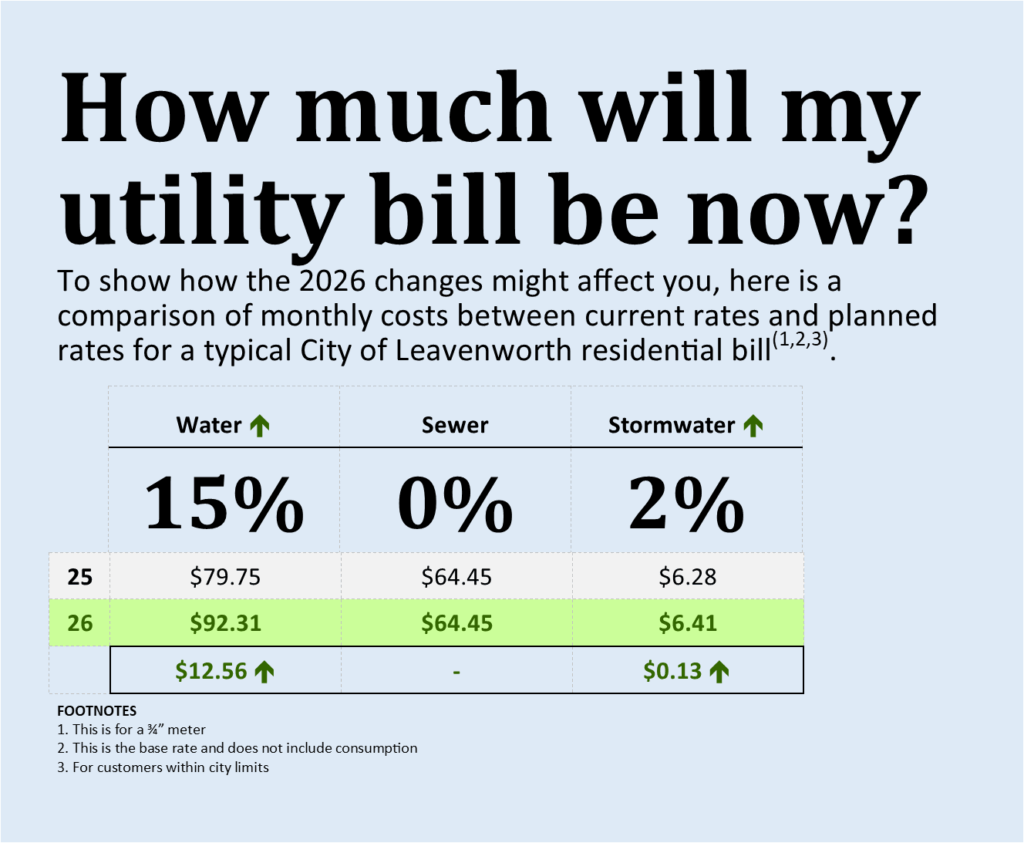
Following an in-depth Utility Rate Study, the Leavenworth City Council voted to move forward with the recommended changes to the City’s utility rates each year. To minimize the impact on you, these increases will occur annually, with the first one effective on January 1, 2026. The approved rate plan is designed to keep costs low for customers while covering increasing operation costs, paying for needed major upgrades, and promoting water and energy conservation.
2026 Resources:
Water & Sewer Capital Project List
2026 Residential Utility Bill Estimator
Resolution 25-2025 Adopting System Development Charges
Utility System Development Charges (SDC) Calculator
2025 Resources:
December 17 – City Council Special Meeting Packet
December 17 – City Council Special Meeting Recording
November 26 – Study Session Recording
Questions?
Call (509) 548-5275 or email hello@col.dev.3sherpas.com.
Calculate your 2026 Utility Rate
Why are the rate increases needed?
- Aging Infrastructure Needs. Many underground utility lines are decades old. Without proactive upgrades, emergency repairs cost 3 to 5 times more and cause major disruption.
- Utilities Must Pay for Themselves (Enterprise Funds). Utility services are funded only by the money collected from rates. We cannot legally use other City funds (like lodging tax) to pay for these operations and projects.
- Joint Roadway Projects Save Money. We are coordinating utility repairs with major street projects. This saves taxpayer money and minimizes disruption by preventing us from having to tear up a brand new road later to fix a broken pipe underneath.
- Regulatory Compliance. Meeting updated safety and environmental standards requires continual investment to keep our utilities safe and sustainable.
- Conservation Goals. New pricing structures encourage responsible water and energy use, aligning with our sustainability goals.
How do rate increases benefit me?
Improved Reliability |
Reduces service outages and ensures continuous, quality water delivery. |
Taxpayer Savings |
Allows the City to coordinate utility upgrades with major road projects. This saves taxpayer money and minimizes future road disruption. |
Specific Projects |
Funding goes toward critical utility upgrades on streets like Cedar, West Center, Stafford, Poplar, and Division. |
Utility Conservation |
New rate structures encourages responsible use, supporting our community’s sustainability goals. |
Climate Resilience |
Modern utility upgrades often involve preparing systems for extreme weather events (e.g., higher flow rates for storm runoff, protecting lines from flooding, etc.). This ensures the system remains operational when it’s needed most. |
Breakdown of Rates Increases in 2025
- For residential water service, the monthly base rates will see an increase of about 3%, or $77.36 to $79.52 for a ¾-inch meter. Consumption rates start at 98 cents per 1,000 gallons for the first 4,000 gallons used and incrementally increase.
- For multi-family water service, the monthly base rates will see an increase from $17.87 to $23.56 per residential unit inside city limits. The consumption rate was slightly lowered, at a flat rate of $1.14 per 1,000 gallons.
- For commercial water service, the monthly base rates will see an approximate increase from $45.48 to $57.18 for a ¾-inch meter. The flat consumption rate is $1.44 per 1,000 gallons.
- For water, the 7,500 gallons per month per meter allowance was removed.
- For sewer, there are slight increases for multi-family monthly rates, from $35.52 per dwelling unit to $37.99 per dwelling unit, and commercial, from $68.60 per Equivalent Residential Unit (ERU) of water used to $80.61 per ERU. There are no changes to residential sewer rates.
- Stormwater monthly rates will increase from $6.16 to $6.28 for residential, multi-family, and commercial low-impact.
- A single-family home with an ¾-inch water meter will see an average of $12.14 increase in monthly rates for water, sewer, and stormwater. A multi-family structure with 6 units will pay about $13 more per unit and a structure with 30 units will pay about $9.36 more per unit.
- For a small commercial account, with no grease, the average monthly bill will increase by approximately $34.65. A large restaurant with a 1-inch meter will have an average $285.97 monthly increase. A medium to large restaurant with a 2-inch meter will see a $292.65 increase. A 100-room hotel will see about a $583.61 increase.
- The newly adopted water system development charge (SDC) will increase for an ¾-inch meter from $3,898.80 to $6,685.00. All water SDCs will increase proportionally based on the meter size.
